
Improved Employment Supports for Autistic Adults
The Problem
In the U.S., employment status predicts health and is related to one’s financial stability, access to health care, and well-being. An estimated 5.5 million adults in the U.S. are on the autism spectrum. People on the autism spectrum often have social communication difficulties, focused interests, and repeated behaviors. These difficulties and differences could affect employment for autistic adults by impacting how an individual performs on a job interview and what kinds of jobs are available. Unemployment places autistic people at higher risk of having poor health and a lower quality of life.
There are two kinds of publicly funded employment programs: Medicaid and Vocational Rehabilitation (VR). Medicaid is a key insurance program for the autistic population. Medicaid covers employment supports for autistic people who are eligible. State Medicaid agencies pay for employment services using home and community-based services (HCBS) waivers through federal and state Medicaid funds. However, only 1% of autistic adults that are estimated to need employment supports receive them.
States offer shorter-term VR services to help autistic adults get and keep paying jobs. Around two-thirds of autistic people who apply for VR receive these services. About two-thirds of autistic people who receive services get a job. Additionally, too many autistic people that need employment supports are not getting them. Current Medicaid programs and traditional state VR services do not cover enough autistic people or provide enough support.
Unemployment and Autism
The exact unemployment rate for autistic adults is unknown. However, previous research has shown that only about 53% of autistic young adults aged 18-24 will have at least one paid job in the first eight years after finishing high school.
Autistic adults that want and need employment supports do not always get help from employment service systems. Approximately 25% of autistic young adults who never work also cannot access employment supports. Autistic adults that do become employed and receive employment supports often receive low pay. Working for low wages increases autistic adults’ risk of living in poverty, going hungry, and becoming unhoused.
Key Takeaways
- Autistic adults experience lower rates of employment than non-autistic adults,
which can lead to negative health and life outcomes. - Current publicly funded employment services are not enough to serve all autistic people that want and need support.
- Expanding HCBS autism waivers, increasing employment opportunities for autistic youth, and changing the funding formula for VR could increase access to employment supports for autistic people across all fifty states.
Medicaid-Funded Employment Supports for Autistic Adults
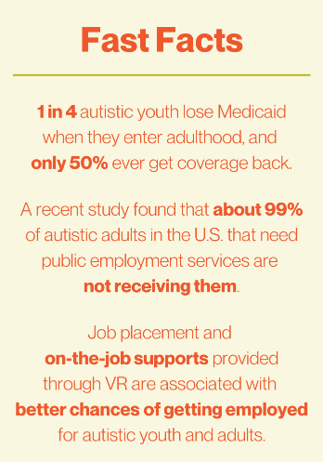
People must meet specific disability criteria to enroll in Medicaid. People with disabilities can also qualify for Medicaid based onlow income. The main types of Medicaid- funded employment services are habilitation services and supported employment services. Habilitation services help people with disabilities like autism learn more about their current skills and teach them new skills needed to get a job. Supported employment services help disabled individuals find and keep employment. People that get supported employment services often receive support from a job coach who helps them get used to completing job activities and checks in on them during their employment. Medicaid- funded employment services are meant to provide long-term support to individuals with disabilities. The availability of these services differs by state.
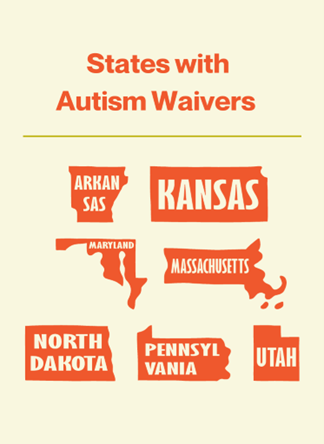
Home and community-based services (HCBS) can fund employment supports for people with disabilities. HCBS waivers allow autistic people and others with disabilities to live, work, and receive services in the community instead of in an institution or hospital. Each state has different HCBS waivers. In 7 states, there are HCBS waivers specifically for autism. Not everyone that needs HCBS waivers can receive them. HCBS waiting lists are very long in many states. This means that Medicaid employment services are not accessible to all who need them.
State Vocational Rehabilitation Services
State VR services assist people with disabilities in getting and keeping employment. Examples of state VR services are job search services, job placement assistance, supported employment, providing assistive technology, and other types of support services individuals may need to get or do their job. VR services also give people an equal chance to interact with co-workers who are not disabled. These services are different from traditional Medicaid employment services because they are meant to provide short-term support. VR services are discontinued once an individual holds employment for 90 days.
VR services are available in all states. But some states essentially have waitlists due to “order- of-selection” policies. Order-of-selection policies are meant to make sure that people most in need of VR services get them first. These policies were put in place because VR services are under-funded. Some states would need additional funding to meet the needs of more all people with disabilities who are eligible for VR in their state.
Many individuals that need VR are not able to receive it. Autistic adults, in particular, may not meet eligibility criteria for VR services, as some states require people to have an intellectual disability to qualify for services.

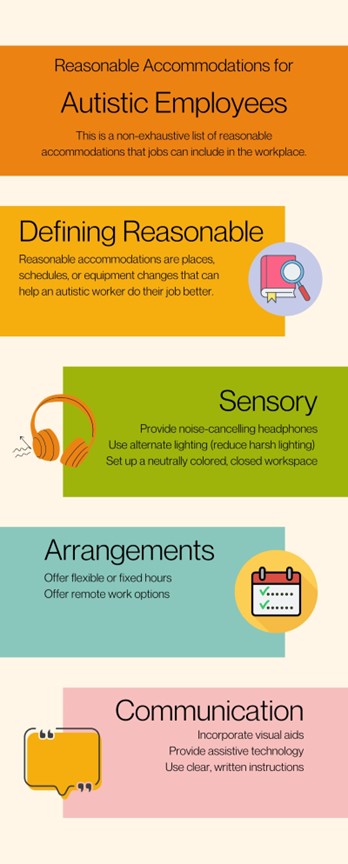
Creating an affirming work environment for autistic adults starts in the interview process. A few ways to do this include making interviews less structured and asking candidates to do practical skill tests. This places the focus on a candidate’s skills and fit for the role rather than their ability to communicate about their skills. Any questions asked should be clear, precise, and detailed. Verbal directions should be short.
Source: Cooper AA, Mujtaba BG. Assessment of Workplace Discrimination against Individuals with Autism Spectrum Disorder (ASD). Socioeconomic challenges. 2022;6(2):19-28. doi:10.21272/sec.6(2).19-28.2022
Existing Laws to Support Employment for Autistic Adults
There are federal laws that protect workers with disabilities against discrimination in the workplace and help provide them with accommodations they need to work. The Americans with Disabilities Act (ADA), passed in 1990, makes it against the law to discriminate against disabled people in employment. The ADA says that workers with disabilities must have equal access to “reasonable accommodations.” Reasonable accommodations are places, schedules, or equipment changes that can help an autistic worker do their job better. Employers decide what reasonable accommodations are.
Employers can deny accommodations autistic workers ask for, but people can also legally challenge these denials. Research shows, however, that autistic people get jobs less often because they are not able to get reasonable accommodations.
Other federal laws are supposed to help people with disabilities like autism get and keep paying jobs. The Workforce Innovation and Opportunity Act (WIOA) became law in 2014. The WIOA aimed to increase access to employment, education, training, and support services for people like those on the autism spectrum that have trouble getting jobs. The WIOA required states to direct more of their VR funds to pre-employment transition services for transition-age youth and people with the highest levels of employment support needs, but it did not give more money to states to run their VR services. The WIOA is a newer version of a previous law called the Rehabilitation Act of 1973.
These laws are not enough to help autistic people get hired and work in paying jobs. More policy solutions are needed to decrease autistic adult unemployment.
Policy Solutions
- Expand HCBS autism waiver availability to more than just 7 states.
- Among states that have autism waivers, only one state (Pennsylvania) has a waiver that serves autistic adults.
- The ability to provide autism-specific services through HCBS waivers is poor, as there are far more waiver “slots” for children than adults, even though there are more autistic adults than there are
- The 43 states that do not currently have HCBS autism waivers can model how others have implemented these waivers in an efficient and cost-effective way.
- Integrate employment discovery opportunities into existing childhood systems.
- Implement work-based learning services (through VR’s pre-employment transition services program) to encourage young people to begin thinking about future careers and explore potential job opportunities.
- Increase the employment discovery opportunities in high school to better prepare autistic youth for employment.
- The federal government should change the way they determine funding for state VR.
- The federal government funds VR services based on a formula that considers a state’s population, average income per person, and previous funding received by the state.
- The current VR funding formula does not take into account differences in costs to provide services across states. For example, rural areas may have fewer community resource agencies to provide VR services and may require more travel.
- Funding needs to better account for the needs of people with disabilities in each state, cost to provide VR services, rising inflation.
Written by:
Liza Tomczuk, MPH
